Newsletter Pricing: Publishers are leaving money on the table study shows


The single biggest opportunity we found in the 2026 Niche Newsletter Revenue Survey is simple: Most publishers underprice newsletter ads.
So how much should a B2B or B2C niche publisher charge based on list size and ad inventory? Is pricing different between B2B and B2C? And where, exactly, are publishers leaving money on the table?
Here’s what data from the survey — and industry benchmarks — tells us.
1. Standard vs. premium pricing
Selling newsletters on a CPM basis is not recommended. However, it is useful to back into a CPM to create apples-to-apples comparisons across publishers and products.
Where things break down is when publishers don’t clearly separate standard from premium inventory (exclusive sends aside — we’ll get to those).
Quick rule of thumb
- If the sponsor gets guaranteed placement and exclusive visibility, it’s premium, even if there is just one ad per newsletter sold.
- If they’re one of several messages in the flow, it’s standard.
A. B2B newsletters
Industry newsletter sources show a fairly typical (openers) CPM rate, much higher than website CPMs:
- Standard ads (non-exclusive, non-guaranteed placement):
$25–$45 CPM - Premium ads / sponsorships (presented by, top-of-newsletter, guaranteed above-the-fold):
$40–$100 CPM
Across industry sources, premium ads typically carry a ~45% markup over standard placements.
What our niche B2B Sample showed
The good news: most B2B publishers in our survey sample beat industry pricing for both standard and premium newsletter ads.
Even though the sample was a snapshot (not a statistically representative survey), results were surprisingly strong. CPMs ranged from $10 at the low end to $167 at the high end, calculated against total sends (not just opens). Some newsletters only run one ad per issue, making them exclusive, and thus premium by default.
- Average standard CPM: $57
- Average premium markup: 71%
This over-performance by the top tier in the survey shows a pricing opportunity for other publishers,; almost half of the B2B publishers in the snapshot report priced below even industry averages.
A fast take on where you stand: The rule of 50
For and B2B newsletter publishers, if you’re pricing below the equivalent of $50 CPM — or marking premium inventory up less than ~50% — price increases may be the low-hanging fruit.
B. B2C newsletter pricing
Industry data shows standard B2C newsletter pricing typically backs into:
- $15–$30 CPM (Paved)
- $15–$35 CPM (beehiiv)
That gives B2C publishers a defensible standard range of $15–$35 CPM against opens.
Premium B2C placements generally land in the $25–$45 CPM range, or occasionally higher for:
• Highly trusted brands
• Identity-based audiences
• High-value or hard-to-reach consumers
What our B2C survey sample showed
Some B2C publishers outperformed benchmarks even more dramatically, but others could easily raise prices.
- CPMs ranged from $2 to $88
- Premium markups reached ~50%
Again, while the sample size is small, the signal is clear: price ceilings are higher than many publishers assume.
2. Structuring campaigns to earn premium pricing
Pricing isn’t just about CPM math. Premium pricing controlled by the publisher is driven by scarcity and dominance. A more generalized pricing factor is association with a high-end, and/or much-loved brand, a factor that influences the pricing model.
Industry sources said high-value premium attributes for both B2B and B2C include:
Guaranteed top or near-top placement
Visual and narrative dominance
Fewer competing messages
Category exclusivity
Co-branding with “Presented by” sponsorships
First content block or hero native units
Issue sponsorships
What our niche sample showed were unique extra factors:
More kinds of exclusivity, such as newsletter takeovers
Much larger and/or native formats
Bundling with website ads as the value ad
Tying newsletters to top-tier event sponsorships
Content marketing and video
Limiting available inventory
All of these tactics raise the value and thus the pricing for premium ads. Recommendation: When in doubt for premium ads, add serious value.
3. How many ads per newsletter?
Price is also affected by the number of ads in the newsletter, which by nature, splits the number of clicks.
A common practice in both the industry and our survey is 1–2 sponsors per issue, especially if you want to protect engagement and create scarcity. However, that is not always the case for newsletters with high traffic (40,000+ emails).
Some industry sources said that playbooks tie ad load to content length (e.g., 1–2 ads per 1,000 words). We recommend a blended approach:
- Up to 10,000 sends and ~1,000 words: 1–2 ad
- Stick to one if CTRs are soft
- Use two if engagement remains strong
Getting around inventory limits (the smart way)
• Increase frequency
Some publishers stay weekly because original content is expensive and core to their value. Others shift formats.
Simon Owens Media moved from original case studies to curated “quick hits,” increased frequency, and created five premium exclusive opportunities-per-week — all native, in-feed, and visually consistent.
• Add a second exclusive position
Insightful Accountant expanded its newsletter takeover by adding a second placement. With no room to add frequency, they added scarcity inside the same send — and sold out.
• Use text-based or classified formats
Podnews.net runs multiple classified-style ads and still feels light because most ads are text-based. Readers actually value the jobs and events listings.
4. Exclusive sends
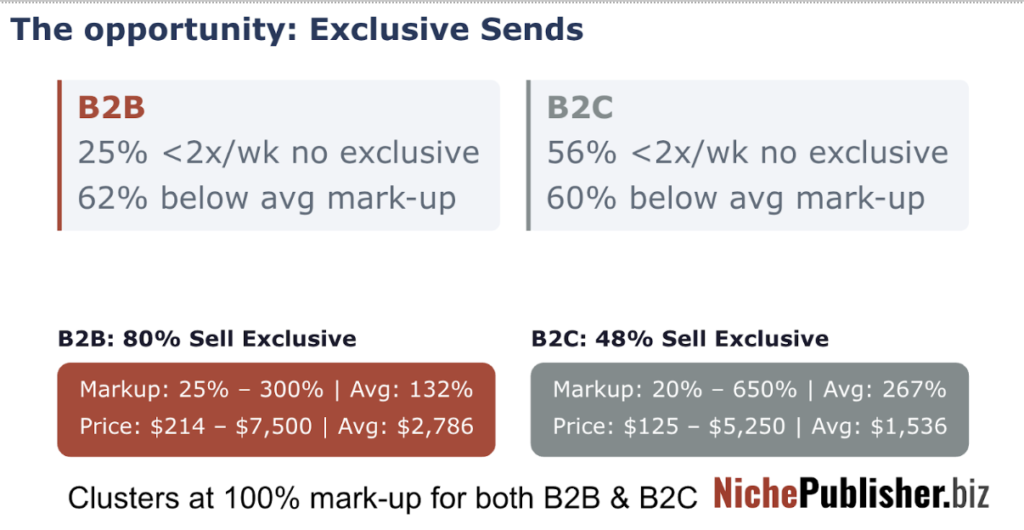
Industry data shows exclusive sends – sending only the advertisers’ content to the list in a newsletter format – are typically priced at ~3× the standard rates.
Example: Standard: $500–$750, Exclusive send: ~$1,500 (AdMailer)
Exclusive sends work especially well for lower-frequency newsletters, where opt-out risk is lower. This is one of the biggest pricing opportunities we see for niche publishers.
What our sample showed
Only a small number of publishers priced exclusives at the full 3× industry markup.
• Most clustered around 2×
• But some exceeded industry averages, achieving 3×–6×. Notably, B2C publishers performed well here — especially when exclusives included content marketing and/or video.